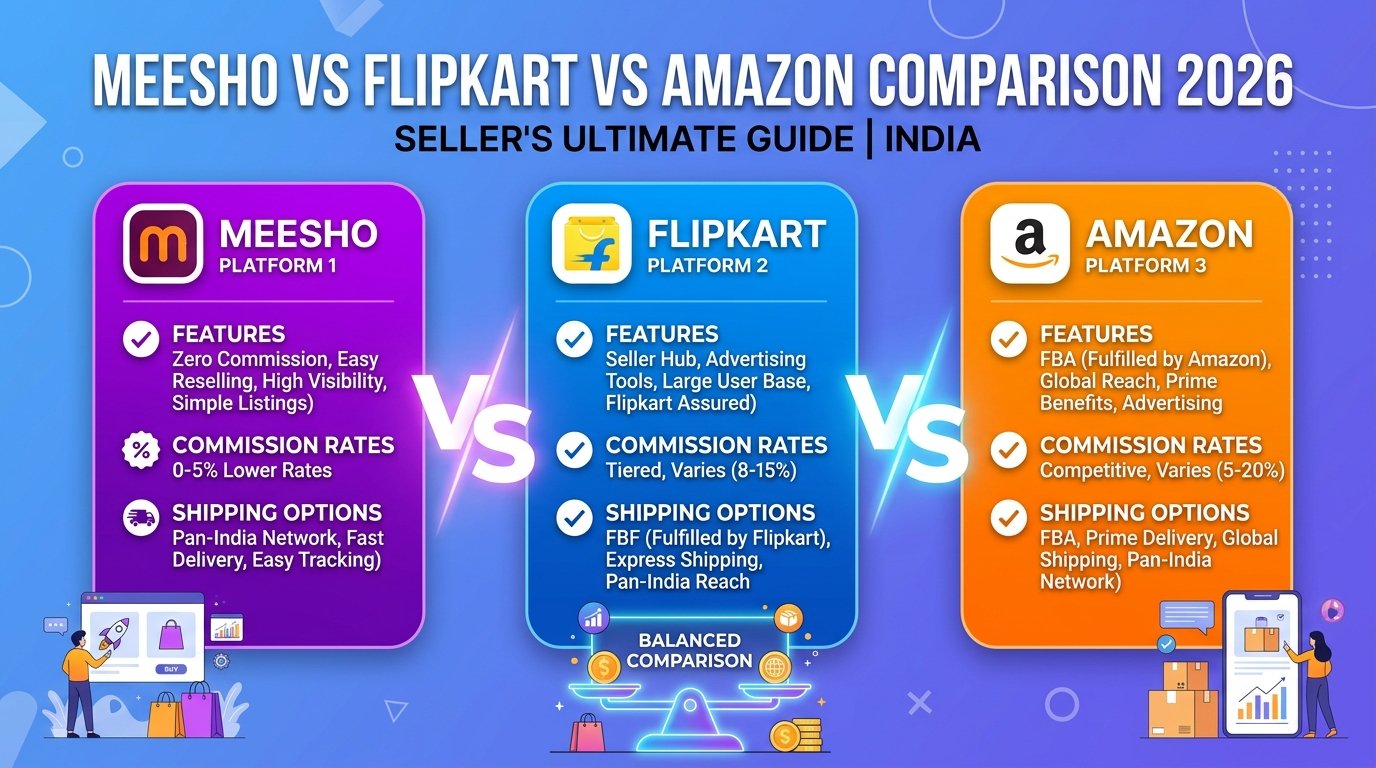
Starting an e-commerce business in India in 2026 has never been easier — but choosing the right platform to sell on can be overwhelming. The three dominant platforms for Indian sellers are Meesho, Flipkart, and Amazon India. Each has its own strengths, weaknesses, commission structures, and target audiences. In this comprehensive comparison, we break down everything a new seller needs to know to make an informed decision.
1. Getting Started: Ease of Registration
Meesho
Meesho has the lowest barrier to entry. You can register as a seller with just your Aadhaar card, PAN card, and a bank account. No GST registration is required for sellers with annual turnover below ₹40 lakhs (₹20 lakhs for some states). The entire registration process takes less than 24 hours, and you can start listing products immediately. This makes Meesho ideal for first-time sellers and home-based businesses.
Flipkart
Flipkart requires GST registration for all sellers (except for certain exempted categories). You also need a PAN card, bank account, and a valid business address. The registration process takes 2-3 business days including address verification. Flipkart assigns you an account manager once you reach a certain volume, which can be helpful for troubleshooting.
Amazon
Amazon India has the most rigorous registration process. You need GST registration, PAN card, bank account, brand authorization (if selling branded products), and product images meeting Amazon's strict quality standards. The approval process can take 3-7 business days. However, once approved, you get access to the largest customer base in India.
2. Commission & Fee Structure
Understanding the fee structure is crucial because it directly impacts your profit margins. Here is a simplified comparison:
- Meesho: 0% commission on most categories (Meesho makes money through customer delivery charges). This is the most seller-friendly fee structure and the primary reason many small sellers start on Meesho.
- Flipkart: Commission ranges from 5-25% depending on the category. Clothing and fashion is typically 10-15%. Additional charges include fixed fees (₹6-30 per order), shipping charges, and collection fees. Total deductions can range from 15-30% of the selling price.
- Amazon: Referral fees range from 6-27% depending on the category. Additional charges include closing fees (₹4-30), Easy Ship charges, or FBA fees (if using Fulfilled by Amazon). Total deductions are similar to Flipkart at 15-35% of the selling price.
3. Return Policies
Returns are a major concern for clothing and fashion sellers. Each platform handles returns differently:
- Meesho: Has a quality check at the delivery hub. If the product fails quality check, it is returned to the seller. Customer return window is 7 days. Meesho bears the return shipping cost for quality-check failures.
- Flipkart: Offers 7-30 day returns depending on the category. The seller bears the return shipping cost in most cases. Flipkart has a "seller protection fund" but it does not cover all return scenarios.
- Amazon: Has the most generous customer return policy (30 days for most categories). This means higher return rates for sellers, especially in clothing. Amazon offers A-to-Z guarantee protection for buyers, which can sometimes result in refunds even without the return of the product.
4. Target Customer Base
- Meesho: Primarily targets Tier 2, Tier 3, and rural India. Customers are price-sensitive and look for budget products. The average order value on Meesho is ₹200-500. Best for sellers offering affordable clothing, home decor, and daily-use products.
- Flipkart: Has a mix of Tier 1, Tier 2, and Tier 3 customers. Known for electronics, fashion, and home appliances. Average order value is ₹500-2,000. Flipkart's Big Billion Days sale can drive massive volume for prepared sellers.
- Amazon: Strongest in Tier 1 cities with more affluent customers. Known for electronics, books, premium fashion, and imported products. Average order value is ₹800-3,000. Amazon Prime members tend to be loyal and high-spending.
5. Shipping & Logistics
- Meesho: Uses its own logistics network and third-party partners. Shipping is managed by Meesho — sellers just need to pack and hand over to the courier. Delivery speed is typically 5-7 days.
- Flipkart: Uses EKart Logistics (Flipkart's own courier) and third-party partners. Flipkart also offers Flipkart Fulfilment (similar to Amazon FBA) where they store and ship products from their warehouses.
- Amazon: Offers Easy Ship (seller packs, Amazon ships) and FBA (Amazon stores, packs, and ships). FBA provides Prime eligibility, which significantly boosts visibility and sales. However, FBA has storage fees and strict packaging requirements.
6. Label Printing & Order Management
Regardless of which platform you choose, you will need to print shipping labels for every order. Each platform generates labels in different formats:
- Meesho: Generates landscape 4×4 inch labels with SKU, size, and customer info
- Flipkart: Generates portrait labels with shipping info on top and tax invoice on the bottom half
- Amazon: Generates portrait 4×6 inch labels with barcode and order details
Pro tip: If you sell on multiple platforms, use EasyOrderLabel to sort and crop labels from all three platforms. Our tool automatically detects whether your PDF contains Meesho, Flipkart, or Amazon labels and adjusts the crop dimensions accordingly.
Our Recommendation for New Sellers
If you are just starting your e-commerce journey, we recommend this approach:
- Start with Meesho to learn the basics of order fulfillment, packaging, and customer service without worrying about high commission rates or GST registration.
- Once you reach 50+ orders daily on Meesho, register on Flipkart to diversify your sales channels and reach a different customer segment.
- Add Amazon when you are ready for the premium market and can invest in better product photography, brand registration, and potentially FBA.
Selling on multiple platforms simultaneously reduces your dependence on any single platform and maximizes your reach. Tools like EasyOrderLabel make it easy to manage labels from all three platforms through a single workflow.